Why this guide
In my practice I meet patients almost every day who are interested in Ultherapy, and who are often confronted with information that is either too superficial, simplifies too much, or makes unrealistic promises.
Ultherapy PRIME is one of the most thoroughly researched procedures for non-surgical skin tightening. At the same time it is a treatment that demands patience, a deep anatomical understanding, and a realistic sense of what it can achieve and what it cannot.
This guide is meant to do exactly that: give a medically grounded, evidence-based account that neither understates nor exaggerates. Written for people who want to understand what happens in their skin during an Ultherapy treatment, before they decide for or against it.
At The Retreat we do not see Ultherapy as an isolated cosmetic treatment, but as part of a broader concept of regenerative aesthetics and longevity medicine. Our aim is not to hide age, but to slow the ageing process at cell level and support the body’s own regeneration.
What is Ultherapy PRIME?
Ultherapy PRIME is the latest generation of micro-focused ultrasound technology with visualisation (MFU-V), made by Merz Aesthetics. The procedure uses focused ultrasound energy to reach deeper layers of the skin in a targeted way, and to stimulate the body’s own collagen and elastin production there.
What sets it apart from earlier Ultherapy generations comes down to three things. First, the visualisation, which lets me see the treated tissue layers in real time on a monitor. That means I am not working blind: I can deliver the ultrasound energy precisely at the anatomically correct depth. Second, the improved applicator technology, which allows a more even distribution of energy and, crucially, considerably better tolerability. Third, the refined treatment speed, which shortens sessions and reduces discomfort.
Ultherapy is FDA-approved and CE-certified in Europe for non-invasive skin tightening on the face, neck and décolleté. It is one of the few procedures approved for treating the platysma band, a layer of connective tissue in the neck. It is precisely this approval that separates Ultherapy from the many HIFU devices that look similar but have neither the same precision nor the same clinical evidence behind them.
The science: micro-focused ultrasound and the SMAS layer
To understand why Ultherapy works, it is worth spending a moment on the anatomy.
Our skin consists of several layers: the epidermis, the dermis, and the fatty tissue beneath. Below that fatty tissue lies another, particularly important layer: the SMAS (superficial muscular aponeurotic system). The SMAS is the connective tissue structure that is tightened in a surgical facelift. It sits at a depth of about 4.5 millimetres and is responsible for the structural firmness of the face.
With age the SMAS loses tension. At the same time collagen and elastin production in the dermis declines, by roughly one per cent a year from about the age of 25. The visible consequences are familiar: a softening contour, a less defined jawline, cheeks that begin to fall, a less distinct transition between face and neck.
This is exactly where Ultherapy acts. The device works with three different applicators, which deliver ultrasound energy at three clearly defined depths:
The three treatment depths and their purpose
| Depth | Purpose |
|---|---|
| 1.5 mm | to improve skin quality and provide superficial tightening in the upper dermis |
| 3.0 mm | to stimulate collagen in the middle dermis |
| 4.5 mm | to tighten directly at the SMAS, at the depth where surgery works |

At each of these depths the ultrasound waves are focused into microscopically small points. At those points a controlled thermal coagulation occurs: the tissue is briefly heated to around 60 to 70°C. The surrounding tissue is left untouched, and the skin at the surface is neither injured nor visibly affected.
What happens next is a biological process. The body reads the thermal coagulation points as micro-injuries and begins a repair process: fibroblasts are activated and start producing new collagen and elastin. That process takes weeks. It reaches its peak after about 90 days and continues over six months.
This is exactly why Ultherapy is not a procedure for the impatient. The real effect does not appear in the treatment chair, but in the months that follow. It is regenerative medicine in the best sense: your body rebuilds what age takes from it.
Who is Ultherapy PRIME suitable for?
What I observe in my practice is that the ideal candidates for Ultherapy are people with early to moderate skin laxity. In concrete terms: a jawline that is softening without already sagging markedly. Cheeks that are losing tension. A neck whose contour is changing without being pronouncedly slack.
For many people this stage typically begins between their mid-thirties and mid-forties. And here lies one of the most important points I convey regularly in consultation: Ultherapy is part of a gentle-aging concept. It is preventive and early regenerative medicine, not the correction of advanced sagging.
The earlier we begin to stimulate the body’s own collagen production in a targeted way, the more slowly and gently the natural ageing process can be accompanied. People who come to aesthetic medicine only once the skin has already slackened considerably generally have fewer options, and sometimes a surgical procedure is then the more honest recommendation.
Ultherapy is less suitable for patients with very pronounced skin laxity, significant volume loss or severe sun damage. In those cases we recommend combination treatments or, in rare cases, a referral to a plastic surgeon.
How the treatment runs at The Retreat Berlin
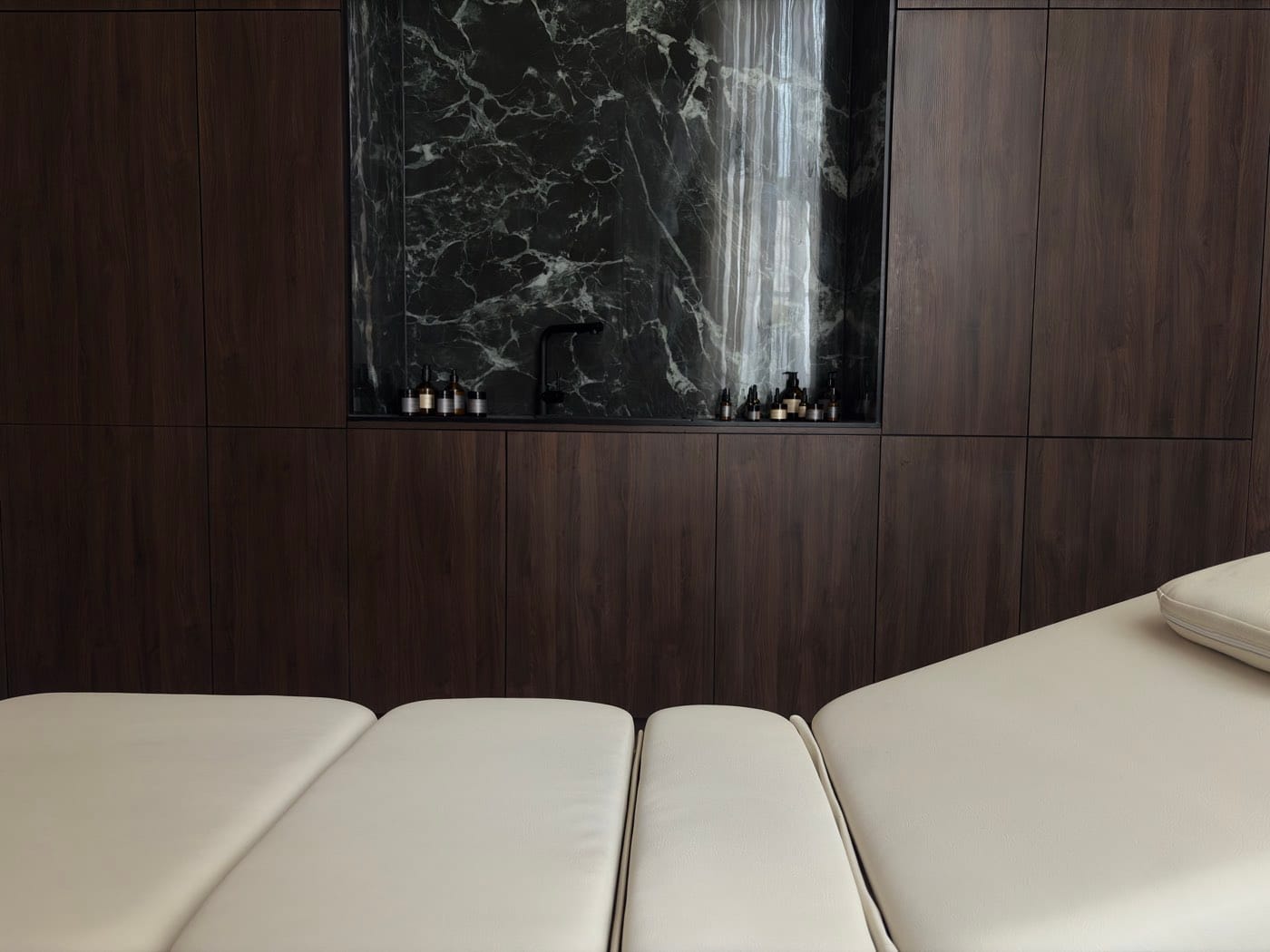
An Ultherapy treatment always begins with a thorough medical consultation. I set aside at least 30 minutes for it, usually longer. In that conversation we analyse your individual facial anatomy, skin quality, the degree of laxity and your specific expectations. I explain what is realistically achievable and what is not. And I ask about possible contraindications and pre-existing conditions.
Only when we are both convinced that Ultherapy is the right decision do we plan the treatment. The treatment itself takes between 60 and 90 minutes, depending on how many zones are treated.
Before the session we apply a highly concentrated anaesthetic cream. This is a detail that many clinics underestimate, and one of the most common reasons people report negative Ultherapy experiences. Inadequate anaesthesia makes the treatment needlessly unpleasant. At The Retreat we therefore combine the topical anaesthetic, where needed, with further measures to reduce discomfort.
During the treatment I apply an ultrasound contact gel and guide the applicator systematically across the zones to be treated. The monitor shows me the tissue depth in real time, so that I can deliver the energy precisely. Each zone is treated with several “lines”, and the number of lines determines the result as well as the duration and the price of the treatment.
After the treatment the skin can be slightly red and feel a little tight. These reactions usually settle within 24 hours. You can go straight back to work, to sport, to social plans. There is no downtime. This is one of the main advantages over more invasive procedures.
In the weeks that follow, the real effect sets in: invisible at first, then increasingly noticeable and visible.
If you would like to find out whether this is an option for you, we clarify that in a medical consultation.
Book a consultationResults: understanding the 90-day cycle

Many patients ask me right after the treatment: “Can I see something already?” My honest answer: minimally, in most cases.
The immediate effect of Ultherapy is a slight instant tightening from the thermal coagulation. It is noticeable, often visible too, but not dramatic. The actual result only emerges in the weeks and months afterwards, while your body builds new collagen.
The timeline I typically observe:
- Weeks 1 to 4: minimal change, usually perceptible only to you
- Weeks 4 to 8: first clear improvements, the skin looks firmer and more defined
- Months 3 to 4: a visible result, often what patients want to show in before-and-after photographs
- Month 6: the maximum result of the treatment
- Months 12 to 18: a plateau, then a slow fading of the effect
The effect generally lasts between 12 and 18 months. Some patients decide on a refresher treatment after that period, others choose different procedures. In my experience, people who see Ultherapy as part of a long-term gentle-aging concept benefit most.
This is exactly why the biggest mistake I see in Ultherapy patients is impatience. Anyone who breaks off after four weeks in frustration because “nothing has happened” misses the actual effect. Building new collagen takes time, and that time is precisely what makes Ultherapy look so natural. It is not a procedure that changes you overnight. It is a stimulation of the body’s own regenerative processes, and we have to respect their rhythm.
Combination treatments: which approach, and when?
One of the most valuable properties of Ultherapy is how well it combines with other procedures. Because Ultherapy works at depth and introduces no substances into the skin, it complements many other regenerative treatments ideally.
Biostimulators such as Sculptra (poly-L-lactic acid) and Radiesse (calcium hydroxylapatite) also stimulate the body’s own collagen production, though through a different mechanism and in a different layer. The combination is synergistic. A study by Kerscher and colleagues (2019) examined the combination of Ultherapy and Radiesse along the jawline and in the submental area: patients showed significant improvements in skin thickness and firmness over 48 weeks.
Profhilo® takes a different approach from the biostimulators. Its thermally stabilised hyaluronic acid hybrid complexes do not aim at structural build-up but at skin quality: hydration, elasticity and firmness. Precisely because Ultherapy works at depth and leaves the surface untouched, the two complement each other well: one addresses the structure, the other the condition of the skin.
PRP and PRF (platelet-rich plasma and platelet-rich fibrin) supply the body’s own growth factors, which support the regenerative processes Ultherapy sets in motion. This combination embodies the principle of regenerative medicine particularly clearly: your own blood is prepared and used as a signalling agent that amplifies cell activity. With thin, fragile skin in particular, or with patients who prefer the most natural, biological treatment possible, this is one of the most valuable combinations in my repertoire.
Injection lipolysis in the submental area is a particularly elegant combination for patients with a double chin. Injection lipolysis reduces the fat deposit enzymatically, and Ultherapy tightens the skin above it. Together we address both components of the problem, without surgery.
Muscle relaxant (botulinum) acts on dynamic lines by relaxing the muscles of facial expression. Ultherapy acts on skin laxity. The two complement each other ideally and can be carried out on the same day without difficulty.
Microneedling improves skin quality, pores and superficial structure through controlled micro-injuries, which in turn stimulate collagen. Combined with PRF it becomes a regenerative treatment that complements Ultherapy ideally: while Ultherapy works at depth on the SMAS, microneedling addresses the superficial layers of the skin. Together we reach every level.
Which combination is right for you depends on your individual anatomy, your age, your skin quality and your aesthetic goals. That is exactly what we discuss at length in the medical consultation.
Side effects and risks
Ultherapy is a very safe procedure, provided it is carried out by trained medical staff with approved devices.
The most common side effects are mild and temporary: slight redness for 24 hours, a feeling of tightness in the treated zones for a few days, occasionally minor tenderness or temporary swelling. These reactions are part of the intended biological process.
Rarer side effects, which I discuss with you in detail during the consultation, are bruising at the injection points of the anaesthetic, temporary hypaesthesia (a numb sensation) and, very rarely and where the procedure is not carried out properly, temporary nerve irritation.
Worth knowing: in my assessment, the negative Ultherapy experiences circulating online stem in the clear majority of cases from two causes. First, the use of non-certified HIFU devices under the label “Ultherapy”. Second, inadequate treatment protocols: too few lines, the wrong depths, insufficient anaesthesia. Both are avoidable when the treatment takes place in a medically led practice with an approved original device.
Ultherapy PRIME versus the alternatives
Aesthetic medicine offers many procedures for skin tightening. A brief medical assessment:
HIFU devices without FDA or CE approval. Visually similar, technologically not comparable. Without visualisation, and without the clinical studies that support Ultherapy PRIME. In my practice I regularly see patients who were dissatisfied with inexpensive HIFU treatments and then move to Ultherapy.
Thermage. A procedure using radiofrequency technology. It works more superficially than Ultherapy, to a maximum depth of 3 mm, and is better suited to improving skin quality than to structural tightening at the SMAS.
Facelift (surgical). The only option with pronounced sagging. It delivers considerably stronger results, but involves anaesthesia, scars, a healing phase and the risks of an operation. It cannot replace Ultherapy, nor Ultherapy it: they are different procedures for different stages.
Threads and PDO lifts. These work through a mechanical lifting effect and a secondary collagen stimulation. Their effect lasts considerably less long than Ultherapy, with a higher complication rate.
My honest assessment after years in aesthetic medicine: for moderate, preventive and early regenerative tightening, Ultherapy PRIME is the procedure with the best balance of clinical evidence, safety, naturalness of result and absence of downtime.
Costs at The Retreat Berlin
The cost of an Ultherapy treatment depends on several factors: the number of zones treated, your individual anatomy, and the number of “lines” required, which your doctor determines from the examination.
As a guide: for smaller single zones costs start at around 200 euros. For treating several zones, for example the lower face with the jawline and submental area, costs typically range between 800 and 2,500 euros.
We discuss the exact pricing for your individual case in the medical consultation, once we have analysed your anatomy and established the optimal treatment strategy. It matters to us that you know exactly what lies ahead before the treatment, medically and financially.
If you look at Ultherapy in the context of a long-term gentle-aging concept, with one treatment every 12 to 18 months, the annual cost is often below what many people spend anyway on high-quality skincare or on less effective treatments.
Ultherapy in the context of longevity and regenerative aesthetics
At The Retreat we do not understand Ultherapy as an isolated beauty treatment. It is part of a broader concept: regenerative aesthetics and longevity medicine.
Longevity begins at cell level. The biological processes that determine how we age can be influenced: through targeted stimulation of the body’s own regeneration, through mitochondrial training, through optimal micronutrient supply, and through a conscious approach to stress. Ultherapy fits into this concept because it does exactly that: it activates the body’s own collagen production rather than replacing it with external substances.
That is why we work in our clinic with a broad spectrum of procedures that support regeneration at different levels: biostimulators, PRP and PRF, infusion therapies, altitude training, health screenings based on blood values and ageing markers. Ultherapy is one of the visible treatments in that spectrum, and at the same time one of the best scientifically grounded.
At the same time we believe that longevity begins in the mind. In the calm, deliberately designed atmosphere of our retreat we create room to slow down, to regulate stress and to restore the balance between body, mind and cells. Without that balance, even the best treatments remain superficial.
My clinical perspective
After many years in aesthetic medicine there are two points I give every patient to take with them.
Second: Ultherapy is non-invasive and part of a gentle-aging concept. It rebuilds the collagen that declines with age. That is not a cosmetic correction but a regenerative measure. It supports your body in doing what it did as a matter of course in younger years: building healthy, firm connective tissue.
In many patients I observe a shift in perception. After the treatment it is no longer about looking younger. It is about feeling more comfortable in the skin they are living in right now. For me that is the finest form of aesthetic medicine: not backwards, but forwards, into a version of yourself that feels right.
Guide · March 2026
How does hyaluronidase work? How Hylase dissolves filler
Article · October 2025
What actually strengthens the immune system
Article · October 2025